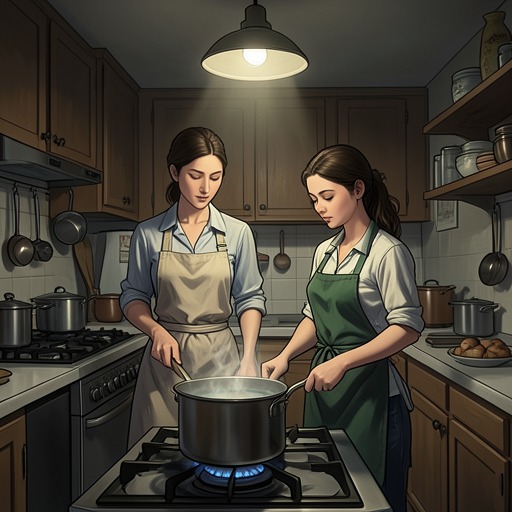
Mama Elena
Like Water for ChocolateMama Elena is the widowed head of the De la Garza household and the mother of Tita, Rosaura, and Gertrudis. She enforces a family rule that assigns the youngest daughter to care for her mother for life, and she uses that rule to deny Tita the choice of marriage. Yet the letters uncovered after Mama Elena’s death reveal that she, too, once loved someone her family would not permit her to marry. The contrast between her concealed past and the restrictions she imposes on her daughters makes her both an agent of family authority and a person shaped by it.
Identity and Hidden History
Mama Elena’s household authority is explicit: she expects her daughters to address her with the deferential form Mami, and she treats challenges to her decisions as challenges to her standing. Tita is the daughter most willing to resist, including in the language she uses for her mother. When Tita once apologizes using the expected form of address, Mama Elena takes it as evidence that she may finally have subdued her youngest daughter. That hope does not last.
After Mama Elena dies, Tita opens the locked box that had once been hidden among the sheets in her mother’s wardrobe. It contains a diary and letters from Jose Trevino. Arranged by date, the letters disclose that he had been the love of Mama Elena’s life and that her parents opposed their marriage because of his racial ancestry. Jose Trevino was the son of an older Jose Trevino and a Black woman; his mother had come to the area with a community fleeing the threat of lynching in the United States. When Mama Elena’s parents discovered the relationship, they forced her into marriage with Juan De la Garza.
Marriage did not end the correspondence. The letters indicate that the relationship between Mama Elena and Jose Trevino continued beyond writing, and reveal that Gertrudis was Jose Trevino’s daughter rather than Juan De la Garza’s. When Mama Elena became pregnant, she planned to flee with Jose Trevino. Before he could join her, an unknown man attacked and killed him. Grieving, she remained with her husband. Juan De la Garza learned the truth on the day Tita was born; the shock brought on a fatal heart attack. These revelations recast the family’s public identities: descent, marriage, and emotional attachment do not neatly coincide, even as the household depends on appearances and inherited rules.
Authority and Tita’s Refused Suitor
Mama Elena presents the youngest-daughter obligation as unquestionable. When Tita is asked whether Pedro Muzquiz intends to seek her hand, Mama Elena tells her that marriage is impossible because Tita must care for her mother until her death. She invokes generations of precedent and rejects the possibility that Tita might dispute the arrangement. Tita, however, sees unanswered questions in its logic: who established the rule, why the youngest daughter is considered most suited to caregiving, and what happens to women who cannot marry or have children. She understands that the household will not entertain those questions, but her doubts mark a refusal to accept the tradition inwardly as well as outwardly.
When Pedro Muzquiz arrives with his father to ask for Tita’s hand, Mama Elena receives them politely and turns the proposal aside. Instead, she offers Rosaura, who is available for marriage. Tita had previously sent Pedro a message asking him to abandon his suit, but the proposal proceeds regardless. Mama Elena’s response protects the household rule while redirecting the marriage arrangement within the family. Her conduct is not simply a private rejection of Pedro: it secures Tita’s continued availability as her future caregiver.
The rule she enforces belongs to The De la Garza Family Tradition Requiring the Youngest Daughter to Care for Her Mother for Life. Tita questions its fairness, including the absence of any evidence that the youngest daughter is better suited to care for a parent. Mama Elena answers such doubt with command rather than discussion. After Tita resists, Mama Elena refuses to speak to her for a week. The silence makes the cost of disagreement tangible without changing Tita’s underlying doubts.
Household Power and Dependence
Mama Elena’s authority is also visible in moments when she faces danger outside the family. When revolutionaries approach the ranch, she orders Tita, Chencha, and a pig into the cellar while she prepares to meet the soldiers. At the entrance to the house, she stands with Rosalio and Guadalupe, concealing a shotgun in her petticoats. The captain recognizes her determination. The scene presents a woman who is guarded and commanding, but also capable of confronting a threat directly to defend her household.
Later, a bandit attack leaves Mama Elena paralyzed from the waist down after she is struck while trying to defend her honor. When Tita returns to the ranch, Mama Elena has disowned her. They exchange no words, but their looks convey reproach, and Tita understands that the bond of blood and obedience between them has been broken. At the same time, Mama Elena needs Tita’s care while she recovers. Tita chooses to prepare her meals carefully, including ox-tail soup, hoping that her mother will regain her health. Their circumstances invert the earlier arrangement: the daughter once ordered to serve is now the caregiver, and the mother who rejected her depends on her work.
Mama Elena does not accept that care without suspicion. She insists that Tita taste the food in front of her, drinks warm milk before eating, and sometimes takes purgatives because she believes the meals may contain poison. When John Brown remarks that Tita is an exceptional cook and says he may ask for her hand, Mama Elena reacts with agitation and insists that Tita cannot marry. Even while physically dependent, she continues trying to determine Tita’s future. Her repeated suspicion makes ordinary meals a site where dependence and control meet.
Death and the Return as a Ghost
Mama Elena dies within a month, suffering severe pain, spasms, and convulsions. Tita and John initially have no explanation, since Mama Elena’s known condition is paralysis. While searching through her bureau, they find a bottle of syrup of ipecac. John explains that it is a powerful emetic that can cause death, and they infer that Mama Elena had been taking it secretly. Her fear of being poisoned had led her to use a dangerous remedy herself. The discovery leaves the precise course of her final illness uncertain, but it connects her death to the private precautions she had taken against Tita’s cooking.
At the wake, Tita looks at her mother and recognizes that she had not understood her while she was alive. She feels no sorrow at their separation, comparing the detachment to a lettuce separated from another lettuce with which it had grown. That response does not erase the weight of their relationship; it describes the distance between them, and Tita’s recognition that closeness had never meant that they truly communicated.
Mama Elena’s authority persists after death through her appearances to Tita. During one confrontation, she accuses Tita of being involved with Pedro and condemns the child she believes Tita is carrying. Tita answers that she has a right to live as she chooses and demands to be left alone. Her declaration breaks the apparition’s hold: Mama Elena’s imposing figure shrinks to a small light and disappears, while Tita’s abdominal and breast pain subsides and she discovers that she is not pregnant. The scene makes the confrontation both emotional and bodily, linking Tita’s release from the ghost’s accusations to the resolution of her false pregnancy scare.
On another occasion, Mama Elena appears while Tita is preparing Three Kings’ bread and again condemns her relationship with Pedro and the presumed pregnancy. Her return places the old commands inside a domestic scene of preparation and work, as if the authority that governed Tita’s choices could still interrupt the ordinary rhythms of the kitchen. The ghost’s continued hostility shows that Mama Elena’s death has not immediately ended her influence; Tita must answer the rules and judgments that her mother embodied before she can escape their power.
Family Legacy
Mama Elena’s life joins two forms of constraint. Her parents blocked her marriage to Jose Trevino because of his ancestry, and she concealed her continuing attachment and Gertrudis’s parentage. Yet as a mother she enforces the inherited caregiving rule against Tita and insists that her youngest daughter cannot marry. Her own history does not lead her to release her daughters from family authority. Instead, the contrast exposes how restrictions can be passed on even by someone who has suffered under them.
The secret history also alters the meaning of Gertrudis’s place in the family. Years later, when Gertrudis has a child with dark skin and Juan threatens to leave her, Tita tells Gertrudis and Juan what the letters revealed. The disclosure establishes Gertrudis’s parentage and helps preserve their marriage. Mama Elena’s concealed past thus has consequences beyond her own household: what she kept hidden becomes evidence that changes how her daughter’s family understands its history.
Mama Elena is therefore not only the obstacle to Tita’s marriage. She is the source of the rule Tita resists, a daughter whose own choices were curtailed, a mother whose hidden relationship unsettles the family’s official account of descent, and a presence whose demands continue after death. Her story’s central irony is not that she lacked suffering, but that her suffering and secrecy coexist with her enforcement of the very kind of inherited authority that denies Tita a life of her own choosing.